
Non-Human Identity Management: Why Machines Need Their Own Governance
Machine, workload and autonomous agent identities are becoming operating actors. The control question is no longer only how they authenticate, but who owns, governs and reviews them.
Identity programs are entering a different operating environment. Machines, workloads and autonomous agents now execute business processes, hold permissions and create operational exposure at a scale human lifecycle models were never designed to govern.
Most identity and access management programs were designed around human lifecycle events. Joiner, mover and leaver processes work reasonably well for employees. They do not work for service accounts, API clients, cloud workloads, robotic process automation or AI agents that can be created, changed and retired outside HR-controlled processes.
The central issue is not only volume. The central issue is accountability.
Non-human identities need explicit ownership, lifecycle control, permission governance, credential management, runtime monitoring and periodic recertification. APIS therefore treats Non-Human Identity Governance as a distinct management discipline rather than a technical subcategory of authentication.
Why This Matters Now
Identity security is at a turning point.
Over the last two decades, organizations have made substantial progress in governing human access. The center of digital execution is now shifting toward machines. Cloud-native systems, microservices, Kubernetes, APIs and agentic AI can create new identities, permissions and cryptographic material in minutes.
The question is no longer whether these identities exist.
The decisive question is:
Who is accountable for them?
That is where the largest governance gap in modern identity programs appears.
The Governance Gap
Current evidence from standards, industry research and operational practice points in the same direction.
- Non-human identities often outnumber human identities.
- HR-driven lifecycle processes do not scale to machines.
- Missing ownership creates orphaned technical accounts.
- Long-lived credentials create persistent security exposure.
- Short-lived cryptographic workload identities reduce authentication risk but do not replace governance.
This distinction matters. A credential can be rotated. A certificate can expire. A token can be revoked.
None of these actions answers the governance question: why does the identity exist, who owns it, what may it access, and when must it be removed?
Identity Is Not Authentication
The market often uses the term Non-Human Identity as a synonym for API keys, certificates, service principals or tokens. APIS considers that definition too narrow.
- An API key is not an identity.
- A certificate is not an identity.
- A token is not an identity.
- They are authentication mechanisms.
The identity is the business-relevant object behind them. It represents a technical actor that performs work on behalf of an application, workload, process or agent. That object needs a lifecycle, an owner, a risk classification and a control model.
The APIS Non-Human Identity Reference Model
APIS separates Non-Human Identity Management into four layers.
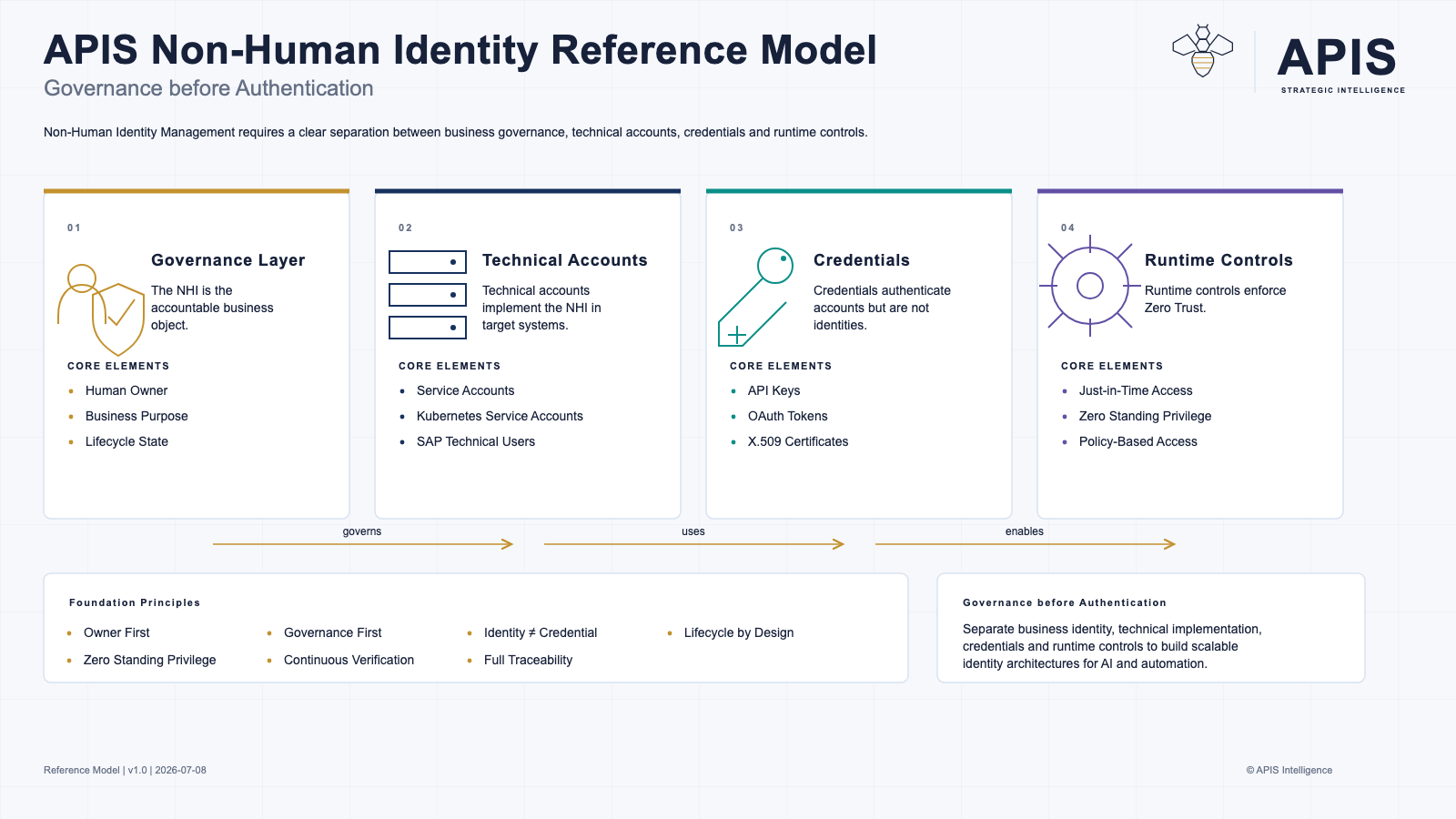
1. Governance Layer
The Non-Human Identity is the governance object.
It describes the business purpose of the machine identity and assigns clear human accountability.
Typical governance attributes include:
- business purpose
- human owner
- lifecycle state
- policies
- risk classification
- compliance requirements
- recertification cadence
The governance identity exists independently of its technical implementation.
2. Technical Accounts Layer
One non-human identity may map to several technical accounts across systems.
Examples include:
- Active Directory service accounts
- Kubernetes service accounts
- SAP technical users
- AWS IAM roles
- Azure managed identities
- OAuth clients
These accounts are implementations of the governance object.
3. Credentials Layer
Credentials exist to authenticate technical actors.
Examples include:
- passwords
- API keys
- OAuth tokens
- X.509 certificates
- SPIFFE SVIDs
Credentials have their own lifecycle. They can be rotated, renewed or revoked without changing the underlying non-human identity.
4. Runtime Controls Layer
Access control becomes effective at runtime.
Runtime controls include:
- just-in-time access
- zero standing privilege
- policy-based access control
- continuous verification
- runtime monitoring
- anomaly detection
- audit logging
This layer turns Zero Trust from a principle into an operating model.
AI Agents Raise the Standard
Autonomous AI agents change the requirement profile.
Traditional service accounts execute deterministic tasks. AI agents can increasingly act based on context. They may request permissions, call external services, trigger workflows, start other agents or coordinate chains of tasks.
This makes accountability harder.
Organizations need controls that answer:
- who authorized the agent
- what intent it is executing
- which permissions it may use
- how its actions are logged
- when its access is revoked
- who is responsible for review
Intent verification, behavioral attestation and accountable agent execution are emerging research and operating problems. They are not solved by credential rotation alone.
Zero Trust Starts With Workload Identity
Governance alone is not enough.
The technical foundation must follow Zero Trust principles. Frameworks such as SPIFFE and SPIRE replace long-lived shared secrets with short-lived cryptographic workload identities. That reduces the exposure created by static credentials.
APIS treats these technologies as important building blocks. They are not a substitute for governance.
The target architecture combines both:
- governed non-human identity records
- mapped technical accounts
- short-lived credentials
- runtime policy enforcement
- continuous audit and recertification
APIS Assessment
The evidence is clear: human-oriented identity lifecycle processes are no longer sufficient for modern digital operations.
The strategic progress does not come from treating every credential as an identity. It comes from separating the business identity, technical accounts, credentials and runtime controls.
This separation improves transparency, supports regulatory accountability and gives organizations a foundation for governing autonomous AI agents.
Non-Human Identity Governance is therefore not a tooling category. It is a control architecture for the next generation of digital operations.
Recommendations
-
Phase 01
Short Term
Control Baseline
Establish visibility, ownership and credential separation.
- Inventory all non-human identities.
- Identify orphaned technical accounts.
- Identify long-lived credentials.
- Assign a responsible human owner to every machine identity.
- Separate credentials from the identity record.
-
Phase 02
Medium Term
Governance Model
Create a lifecycle model that connects identity purpose, access and review.
- Introduce a dedicated NHI lifecycle model.
- Separate governance objects, technical accounts and credentials.
- Automate credential rotation.
- Review all machine identities regularly.
- Map runtime permissions to business purpose.
-
Phase 03
Long Term
Operating Architecture
Move toward governed workload identity and continuous runtime control.
- Introduce workload identities based on SPIFFE/SPIRE or equivalent frameworks.
- Implement zero standing privilege.
- Define governance for autonomous AI agents.
- Add continuous monitoring and accountable review.
- Treat non-human identities as first-class governance objects.
Open Questions
Several questions remain unresolved across the market:
- How can responsibility for autonomous AI agents be assigned clearly?
- How can original human intent be verified during autonomous execution?
- Which EU AI Act obligations will apply to agentic AI operating models?
- Which governance models scale across multi-cloud and multi-agent ecosystems?
These questions will shape the next version of the APIS Non-Human Identity Reference Model.
Conclusion
The core challenge in Non-Human Identity Management is not authentication. It is governance.
Organizations need to know which machine identities exist, why they exist, who owns them, what they can access, which credentials they use and when they must be reviewed or removed.
As cloud-native architectures and autonomous AI agents expand, that discipline becomes a strategic requirement for resilient identity programs.
Companies that treat non-human identities as governed objects today create the operating foundation for the next generation of digital identity.
Sources